

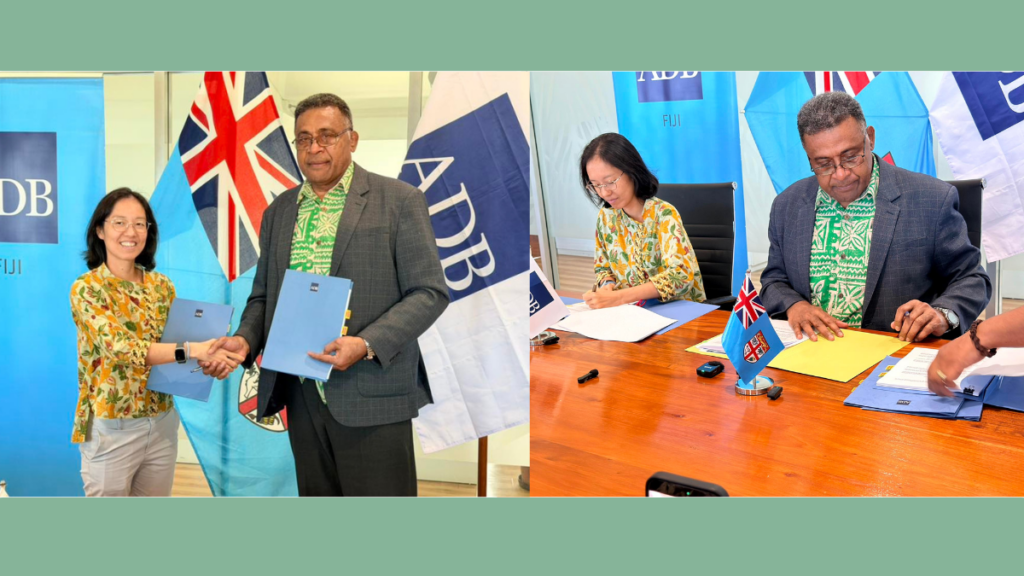
The Government of Fiji has secured a major financing package worth over $149 million following the signing of key agreements with the Asian Development Bank, strengthening the country’s health system and bolstering climate resilience in vulnerable coastal areas.
Speaking at the signing in Suva, Minister for Finance, Hon. Esrom Immanuel said the agreements mark a significant milestone in delivering critical national priorities.
“On behalf of the Government of Fiji and the Honourable Prime Minister, I am pleased to officially sign these Agreements today with the ADB,” he said. “These are strategic investments that will improve the quality of life for our people while building long-term resilience.”
Under the agreements, Fiji will access a $112 million (USD $50 million) concessional loan to cofinance and support the Pacific Healthy Islands Transformation (PHIT) Project, alongside a $37.33 million (USD $16.7 million) grant for the Enhancing Climate Resilience of Coastal Communities Project. Government will also contribute approximately $2.7 million (USD $1.19 million) towards the coastal resilience initiative, bringing its total value to around $40 million.
The PHIT Project forms part of a broader $406.7 million (USD $181.94 million) regional financing package and represents one of the most comprehensive health sector reforms in the Pacific. It will focus on expanding access to quality healthcare services, particularly targeting the growing burden of non-communicable diseases.
“This project will modernise Fiji’s health system, strengthen regional collaboration, and enhance evidence-based decision-making,” Minister Immanuel said. “It is a vital investment in the health and wellbeing of all Fijians.”
He also stressed that the concessional loan—offered on a 40-year term with a 10-year grace period at a 1 percent interest rate—aligns with Government’s fiscal strategy and remains within sustainable debt thresholds.
Meanwhile, the coastal resilience project will focus on protecting ecosystems and communities from climate change impacts through nature-based solutions, improved livelihoods, and stronger institutional capacity.
“The objective is clear—reduce climate vulnerability while empowering communities with the tools and knowledge to adapt and thrive,” the Minister added.
Both projects are expected to be implemented over the next five to six years, with completion targeted by 2031.
Minister Immanuel acknowledged the continued partnership with the ADB and other development partners, noting their critical role in supporting Fiji’s development agenda.
“These agreements reflect the strength of our partnerships and our shared commitment to building a healthier, more resilient Fiji,” he said. “We remain focused on delivering tangible outcomes for our people.”